Fabricating Custom Containers for Auto Manufacturers & Suppliers
Automotive manufacturers and suppliers rely on efficient material handling to keep production moving, but standard containers do not always meet the demands of specialized parts and equipment. This article is written for companies looking to improve storage, transportation, and workflow efficiency with custom-fabricated containers. The perspective reflects Swanton Welding Company’s experience designing and building custom containers for automotive applications. It explains when standard containers fall short, the advantages of custom fabrication, and how purpose-built solutions can support a more efficient supply chain.
Your production line depends on timing. Parts need to arrive in the right place, in the right condition, and at the right moment. When that flow is disrupted, everything slows down. You might be dealing with damaged components, inefficient storage, or containers that simply do not fit the job.
At first, it may seem like a logistics issue. But often, the real problem starts with the containers you are using.
Standard options can only take you so far. When your parts, equipment, and processes have specific requirements, generic containers can create more problems than they solve.
When Standard Containers Fall Short
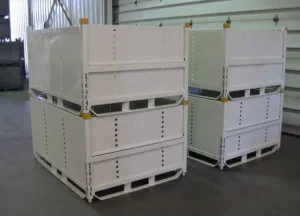
Shipping containers are widely used across the automotive industry for a reason. They are easy to stack, transport, and store. Their uniform size makes them predictable and convenient.
But automotive manufacturing is not uniform.
You are dealing with a wide range of components, from large powertrain assemblies to smaller, delicate parts. Each one has different handling requirements. Trying to fit all of them into a standard container often leads to inefficiencies.
Oversized equipment may not fit at all. Smaller parts may shift during transport. Fragile components may not have the support they need to avoid damage.
When containers do not match the job, your team is forced to adapt. That can mean extra handling, added packaging, or slower loading and unloading times. All of that affects your productivity.
The Real Cost of Improper Storage and Transport
When containers are not built around your needs, the impact goes beyond inconvenience.
Damage during transit is one of the most common issues. A component that shifts or lacks proper support can arrive unusable. That leads to replacement costs, delays, and potential disruptions to your production schedule.
Handling inefficiencies also add up. If your team has to spend extra time loading, securing, or unloading parts, those minutes turn into hours over the course of a project.
Storage can become another challenge. Without the right container setup, keeping parts organized and accessible becomes harder. That can slow down retrieval and create confusion on the shop floor.
These are not isolated problems. They affect your workflow, your costs, and your ability to meet deadlines.
Built to Match Your Specifications
Custom containers offer a different approach. Instead of working around limitations, you start with your requirements and build from there.
At Swanton Welding Company, containers are fabricated to match the specific needs of your operation. That includes size, structure, and internal features that support how your parts are handled and transported.
You are not limited to one type of container. Different formats can be adapted to suit different applications.
Dry containers are commonly used for general transport and can be modified with internal supports and storage features. Flat rack containers provide flexibility for oversized equipment that does not fit within enclosed walls. Tunnel containers allow access from both ends, making loading and unloading more efficient. Side-opening containers give your team better access to long or bulky components.
Each option can be adjusted to fit your workflow instead of forcing your workflow to adjust to the container.
Features That Improve Efficiency
Customization is not just about size. It is about how the container functions in real-world use.
You can incorporate features that make handling easier and safer. Lift points can be placed where your team needs them. Doors can be configured for quicker access. Locking systems can be built to match your security requirements.
Inside the container, racks and supports can be fabricated to hold specific components in place. This reduces movement during transport and keeps parts organized.
Protective elements can also be added to reduce the risk of damage. Padding, bracing, and compartmentalized storage all contribute to keeping components in good condition from start to finish.
Even visual details can play a role. Containers can be finished to align with your branding or labeled to support inventory management.
Supporting Your Supply Chain from End to End
Custom containers do more than move parts from one location to another. They support your entire supply chain.
When containers are built around your process, loading becomes faster and more predictable. Transport is more secure. Unloading requires less effort and fewer adjustments.
This consistency helps your team stay on schedule. It also reduces the chance of errors that can occur when handling is rushed or improvised.
For suppliers, this can improve coordination with manufacturers. For manufacturers, it helps maintain a steady flow of parts into production.
Over time, these improvements can have a noticeable impact on efficiency.
Reliable Storage Between Production Stages
Not every component moves directly from delivery to installation. In many cases, parts need to be stored before they are used.
Custom containers provide a secure and organized way to handle this stage of the process.
Instead of stacking parts or storing them in makeshift setups, you can keep everything contained and protected. This reduces exposure to environmental factors and minimizes the risk of damage or tampering.
It also makes inventory easier to manage. When parts are stored in containers built for that purpose, they are easier to locate and access when needed.
Protecting a Wide Range of Automotive Components
Different parts require different levels of support. A one-size-fits-all approach does not work when you are dealing with both heavy and delicate components.
Custom racks can be fabricated to hold items like engines, transmissions, axles, and radiators securely. These components require strong support to prevent shifting and damage during transport.
At the same time, more fragile items like mirrors, glass, and interior components need a different approach. They require protection from impact and movement.
By tailoring the container and its internal structure to each type of part, you reduce the risk of damage and improve overall handling.
This level of control helps your products arrive in the same condition they left, ready for the next step in the process.
Long-Term Value from a Smarter Approach
Custom containers are built for repeated use. They are not a temporary fix. They are a long-term solution that supports your operation over time.
When containers are fabricated to meet your specifications, they continue to deliver value with each use. Reduced damage, faster handling, and better organization all contribute to lower operating costs.
Instead of constantly adjusting to limitations, your team can rely on a system that works the way it should.
Keep Your Operation Moving
In automotive manufacturing, efficiency depends on more than just production. It depends on how parts are stored, handled, and transported every step of the way. Custom containers help eliminate the friction caused by standard options that do not fit your needs. Swanton Welding Company fabricates containers that align with your specifications and support your workflow from start to finish. If you are ready to improve how your operation moves and stores components, contact us for a quote today.