Welding and Fabrication Strategies for Large-Scale Machinery
The perspective shared here comes from Swanton Welding Company, a fabrication partner that supports heavy equipment manufacturers and large industrial projects through industrial welding, heavy fabrication, conveyor fabrication, and metal rolling services. By working from customer-provided requirements, we deliver fabricated components that support long-term equipment performance and predictable project execution.
Large-scale machinery depends on fabricated components that can handle extreme loads, long duty cycles, and demanding operating environments. The quality of those components influences how equipment performs once it is installed, how often maintenance is required, and how reliably production schedules are met. When fabrication falls short, even well-planned builds can face unexpected setbacks.
From oversized structures to complex assemblies, large-scale machinery fabrication introduces challenges that require experience, coordination, and the ability to execute at scale.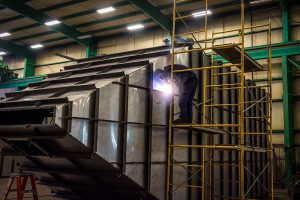
The Problem With Fabricating Large-Scale Machinery Components
Fabricating components for large machinery introduces challenges that go far beyond standard shop work. Oversized dimensions, thick materials, and tight tolerances create conditions where small errors can have real consequences.
One of the most common problems is scale. Large frames, supports, housings, and conveyor structures require specialized handling and workspace. When parts stretch beyond standard fabrication limits, maintaining dimensional accuracy becomes more difficult. Heat input from welding can introduce distortion, especially across long seams or heavy plate sections.
Many manufacturers face capacity constraints in heavy fabrication. Internal teams may be well-suited for smaller components, but lack the equipment or floor space required for large assemblies. As the project scope grows, production bottlenecks appear, and fabrication timelines become harder to manage.
Outsourcing can introduce additional problems. When welding, rolling, and assembly are spread across multiple vendors, consistency becomes harder to maintain. Communication gaps increase, and accountability can become fragmented. Managing quality across multiple fabrication partners adds complexity that many teams are not ready to handle.
Fabrication Missteps
When fabrication challenges are not addressed early, the impact spreads quickly. Welding methods that are poorly matched to load conditions or operating environments can weaken joints over time. Structural fatigue, cracking, or misalignment may not appear immediately, but they surface once equipment enters service.
Material selection can also become a source of frustration. Using materials that do not align with operational demands can increase component weight or reduce service life. In large machinery, added weight affects transport, installation, and the performance of connected systems.
For heavy equipment manufacturers, these issues do not exist in isolation. Production schedules shift. Delivery commitments are strained. Internal teams are pulled away from forward-looking work to manage fabrication fallout. What begins as a shop-level problem can affect customer relationships and long-term planning.
Welding Methods Applied to Real Operating Demands
Industrial welding for large machinery has to align with how components will be used in the field. Load requirements, vibration, exposure, and duty cycles all influence how welds should be applied.
By applying welding methods based on customer-defined requirements, fabricated components are better suited to their intended applications.
Material Choices Reflect Strength and Longevity
Material selection plays a defining role in heavy fabrication. Steel grade, thickness, and alloy properties affect how components handle stress, abrasion, and environmental exposure.
In large machinery, balancing strength and weight is an ongoing consideration. Structural elements have to support heavy loads without introducing unnecessary mass. Choosing materials that align with operational needs helps maintain this balance while supporting durability. This predictability supports smoother installation and operation once components are placed into service.
Heavy Fabrication Capabilities for Oversized Assemblies
Heavy fabrication demands equipment and facilities capable of handling large parts safely and accurately. Lifting capacity, floor space, and fixturing all influence how oversized components are built.
Fabricating large assemblies in a single facility reduces handoffs, and that adds value. Fit and alignment can be monitored throughout the process, reducing surprises during installation.
For manufacturers, this means fewer field adjustments and greater confidence that components will integrate as planned.
Conveyor Fabrication Built Around Material Handling Demands
Conveyor systems rely on fabricated components that maintain alignment over long distances and continuous operation. Frames, supports, and transitions that are consistent will support smooth material flow.
Poor fabrication can introduce tracking issues, uneven wear, and increased maintenance demands. Over time, these problems disrupt operations and increase operating costs.
Metal Rolling Services That Support Accuracy and Fit
Rolled components are common in large machinery. Cylindrical housings, curved frames, and rounded conveyor elements all depend on accurate metal rolling.
Inconsistent rolling can affect fit-up and alignment within larger assemblies. Variations in radius or wall thickness can also create challenges during welding and installation.
Metal-rolling services, performed alongside fabrication and welding, will help maintain consistency. Curved components integrate more smoothly when rolling tolerances are controlled within the same production environment.
Coordinated In-House Project Management
Managing large-scale fabrication requires coordination across multiple disciplines. When project management, fabrication, welding, rolling, and finishing operate under a shared plan, quality control becomes more consistent.
Changes are addressed faster. Inspection criteria remain aligned with fabrication processes. Production schedules stay visible across teams.
Reliable Large-Scale Machinery With a Trusted Partner
Reliable fabrication strengthens every stage of a build. Installation becomes smoother. Maintenance becomes more predictable. Project schedules become easier to manage.
Heavy equipment manufacturers benefit from working with experienced fabrication partners who understand the demands of industrial-scale work. With experience in industrial welding, heavy fabrication, conveyor fabrication, and metal rolling services, Swanton Welding supports manufacturers like you who are building equipment that must perform under demanding conditions.
If you are sourcing fabricated components for large-scale machinery or material handling systems, contact Swanton Welding Company to discuss how our impressive fabrication capabilities can support your next project.

