What Advanced Metal Rolling Can Achieve
Advanced metal rolling allows fabricators to produce more than basic cylindrical shapes, including cones, cyclones, tapered components, and complex curves. This is written for manufacturers and customers with specialized fabrication requirements. Swanton Welding Company provides advanced rolling capabilities in house to produce custom formed components while maintaining control over quality and production schedules.
Metal rolling is often associated with forming a metal sheet into a simple cylindrical shape, but the capabilities of modern rolling equipment extend much further. Fabricators can produce tapered forms, complex curves, and specialized components that would be difficult to achieve with basic bending processes alone.
If you have specialized fabrication requirements, access to advanced rolling capabilities can make a significant difference.
At Swanton Welding, our rolling capabilities support a wide range of applications and component types. From cones and cyclones to other custom shapes, advanced metal rolling allows us to take on challenging fabrication work while maintaining control over quality, consistency, and production schedules.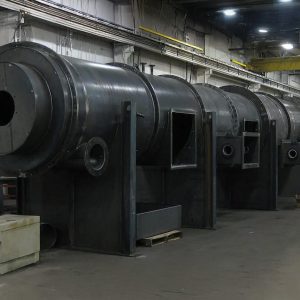
Rolling Goes Beyond Basic Cylinders
Rolling gradually forms flat metal into a curved shape by applying controlled pressure. The process can be used with different materials, thicknesses, and dimensions to produce a variety of finished shapes.
A straightforward rolling application might involve forming sheet metal into a cylindrical section. More complex work can require a tapered shape, a specific radius, or a combination of curves that must meet precise customer-provided specifications.
The complexity of the finished component depends on the requirements of the application. Material thickness, overall dimensions, radius, taper, and the relationship between different formed sections can all affect how the material needs to be processed.
This is where fabrication experience and capable rolling equipment become particularly valuable. Producing a complex shape requires more than simply putting material through a machine. The process needs to be carefully controlled so the finished component meets the required dimensions and can be incorporated into the larger assembly.
Fabricating Cones and Tapered Components
Conical components are a good example of what advanced rolling can accomplish. Unlike a standard cylinder, a cone changes in diameter along its length, requiring the material to be formed into a controlled taper.
Cones and tapered sections can be used in a variety of industrial applications, including material handling equipment, processing equipment, hoppers, and other fabricated assemblies. The exact requirements can vary considerably from one application to another.
The fabrication process needs to account for those requirements so the finished component has the appropriate shape and dimensions. When the component will be joined with other parts, accuracy becomes particularly important because the pieces need to fit together properly during assembly.
Producing Cyclones and Other Complex Shapes
Cyclones provide another example of how rolling can be used to produce more complicated industrial components. These assemblies can incorporate curved and tapered sections, making fabrication more involved than forming a basic cylindrical shell.
Advanced rolling capabilities allow us to take on components with more demanding shapes while maintaining control over the production process.
The same principle can apply to tanks, hoppers, ductwork, shells, and specialty components. The specific applications will vary, but the underlying advantage remains the same: capable rolling equipment expands the range of shapes a fabricator can produce.
Custom Rolling for Application-Specific Requirements
Not every fabrication project involves a standard shape or off-the-shelf component. Customers may require a particular radius, diameter, taper, thickness, or configuration based on how the finished component will be used.
Advanced rolling gives us greater flexibility to accommodate these requirements. Rather than limiting a project to the shapes that are easiest to produce, the fabrication process can be tailored to the specifications provided for the application.
For customers, this means having access to a broader range of fabrication options. Whether your project calls for a tapered industrial component, a curved structural piece, or a specialized formed shape, the right rolling capabilities can help turn those requirements into a finished fabricated component.
Complex Rolling In-House
One of the biggest advantages of having advanced rolling capabilities in-house is the ability to keep more of a project within a single fabrication operation.
When a shop cannot perform a specialized rolling process, the work is sent to another supplier. That introduces another company into the production process, along with additional transportation, scheduling, communication, and handling.
Those extra steps can affect both cost and lead time. If the outside supplier has a backlog, the project may have to wait for an available production slot. If specifications change, coordinating those changes between multiple companies can add another layer of complexity.
In-house rolling reduces those handoffs. It allows the fabrication team to incorporate rolling into the broader production workflow and maintain greater control over how the work progresses.
For customers, that can mean fewer vendors to coordinate, fewer transportation steps, and a more streamlined path from raw material to finished component.
The Value of Advanced Rolling Capabilities
Advanced metal rolling is ultimately about expanding what a fabrication shop can produce. Complex curves, tapered components, cones, cyclones, and other specialized shapes all require capabilities beyond basic metal bending.
At Swanton Welding Company, advanced rolling is part of our broader fabrication capabilities. Our team can work with customer-provided specifications to produce rolled components for a wide range of industrial, structural, and architectural applications.
When a project calls for more than a simple bend, advanced rolling capabilities can provide the flexibility needed to produce the required shape while keeping fabrication quality and production control under one roof. If your next fabrication project requires advanced rolling, give us a call.